

Capacity And Compass — The Two Things Recovery Rebuilds
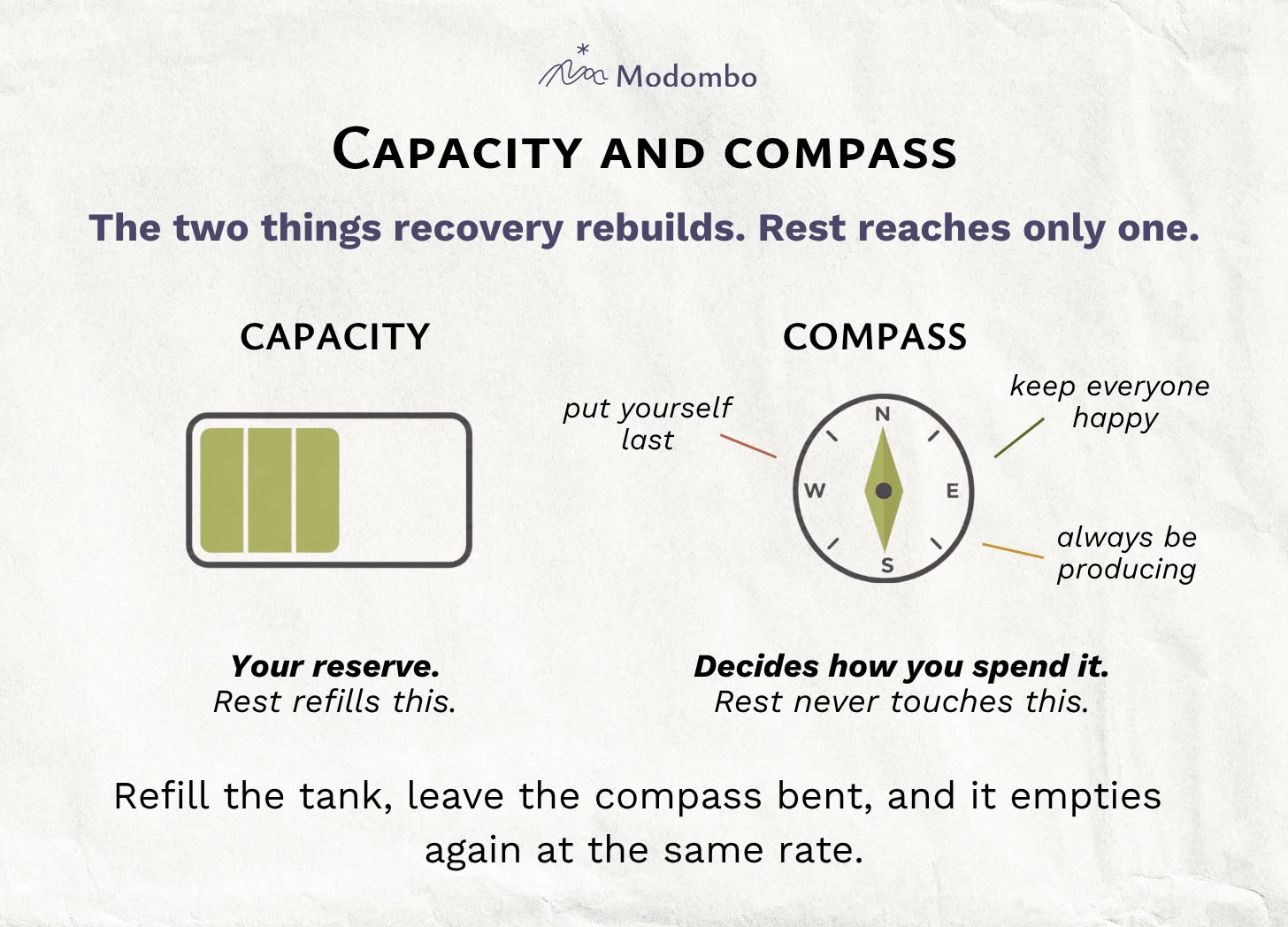
Capacity is what you spend. The compass is what spends it.

Rested by Sunday, empty by Tuesday
You finally did the recovery. You slowed down, you slept, you gave it real time, and it worked. The energy came back. You walked into Monday feeling like yourself for the first time in months. Then by Tuesday, sometimes by Tuesday lunchtime, it was gone again, and you were back where you started, wondering how something you worked that hard to rebuild could drain that fast.
If that has happened to you, it was not a failure of the rest. The rest did its job. It refilled you. The problem is what happened to the fuel the moment you had it.
You rebuilt the tank. You never looked at the driver.
Two things, not one
Last time we rebuilt the machinery, the part that turns rest into recovery. That gets your capacity back. Capacity is the reserve you draw on to meet a day, and it is real, and it is half of what recovery is.
Only half. Recovery rebuilds two things. Your capacity, and the compass that decides where the capacity goes. Capacity is what you spend. The compass is what does the spending. Refill the first and leave the second exactly as it was, and the tank empties again at the rate it emptied before, because the thing pointing it has not changed.
This is the Monday reboot. It is not weakness and it is not a discipline problem. It is what happens when you hand a full tank to a driver who is still driving toward the same place.
The part that keeps spending you
So what is the compass. It is the part of you that reads your own signals, the tiredness and the quiet no underneath a yes, and decides whether to listen or override. In a person who is well, it mostly listens. In a person who has been in overload a long time, it has learned to override on its own, without asking you first.
The three drivers
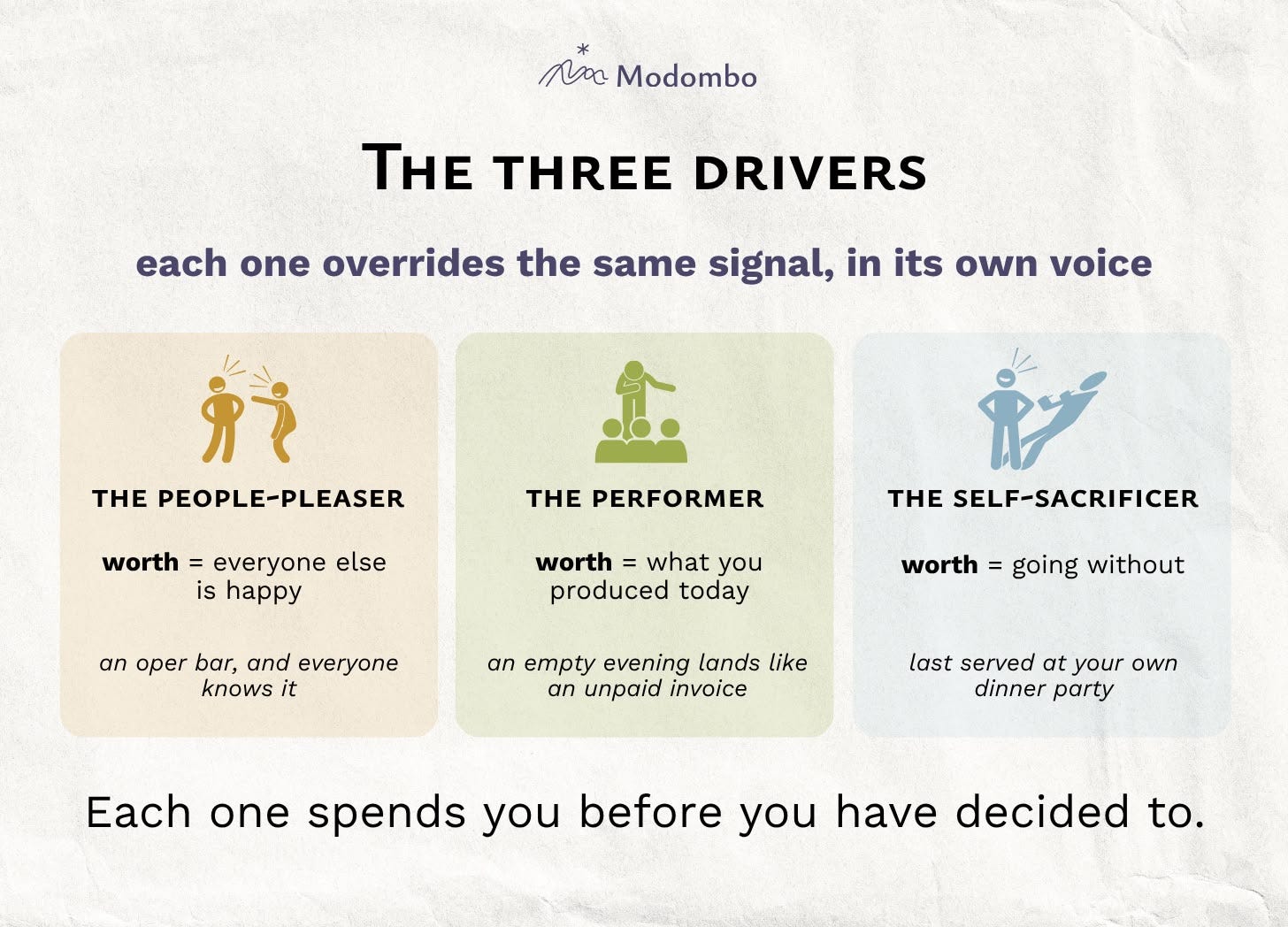
Three identities do most of the overriding. Most people are running at least one, and plenty of us are running two.
The people-pleaser. It measures its worth by how happy everyone else is. It says yes before it has checked whether you have anything left to give, because a no might land badly on someone, and letting someone down feels worse than emptying yourself. You are an open bar, and everyone has worked out that you never close.
The performer. It only feels real when it is producing. Rest reads as laziness to it. An empty evening arrives like an unpaid invoice. It cannot let the tank sit full, because sitting still does not count as being worth anything.
The self-sacrificer. It puts itself last on principle, treats its own needs as the least urgent item on a list that never ends, and quietly calls that being a good person. You are the last person served at your own dinner party, and you are the one who cooked.
None of these is a habit you talk yourself out of in an afternoon. They run underneath the choices, and most of them were rewarded for years before they ever cost you anything. The compass did not break. It was trained.
I ran the third one for two years and called it being useful. In my first company, whatever broke, I fixed. A release process falling over, the accounting in a mess, two people who had stopped talking to each other properly. I saw it, I went straight at it, and the fire always outranked my own work. It certainly outranked anything like learning or rest. After a couple of years of that I was completely spent, and the fix in the end was not a holiday. It was learning to hold people accountable for what was theirs, and to let a fire burn in someone else’s domain long enough for them to put it out. That is compass work, not capacity work, and no amount of sleep would have done it for me.
Not all of it is yours
One honest correction before this turns into a story about your character.
Some of what bends the compass is not inside you at all. A workplace where the demand never lets up will override your signals for you. So will a boss you cannot read, or a person you love who genuinely cannot wait. In those situations you can have a perfectly good compass and still get emptied, and the work is not on your identity, it is on the environment or on getting support. Telling the two apart matters enormously, because the wrong fix aimed at the wrong cause does real harm. That is the next episode.
And where it is internal, be honest about the size of it. These identities usually have long roots, often reaching back further than the job that finally exposed them, and they rarely stay in one part of a life. If yours is genuinely load-bearing, it is proper work for therapy or coaching over months, not something a newsletter fixes on a Sunday. I would rather tell you that plainly than pretend otherwise.
Why you need both
There is a trap in each direction.
Rebuild capacity and leave the compass, and you get the Monday reboot. A full tank spent by a driver who has not changed. You are back here in a month, blaming yourself again.
Rebuild the compass and leave capacity, and you get a different stuck. You know exactly what you need, you can feel precisely where your life is pointed wrong, and you have no energy to do anything about it. Clear sight, empty tank. That is its own kind of misery.
Recovery that holds works both at once. It refills the reserve and it slowly changes the hand on the wheel, so that when the capacity comes back, it gets spent somewhere that does not leave you empty by Tuesday.
Seeing the driver
I am not going to hand you the compass work in a letter, because it is the more involved half and it needs the room. That work is the heart of the companion e-book, which comes out in early September.
The full method, the trainable domain practice, the retraining of the driver itself, and the whole sequence in order, is the book’s job. This letter is still the map. The book is still the method.
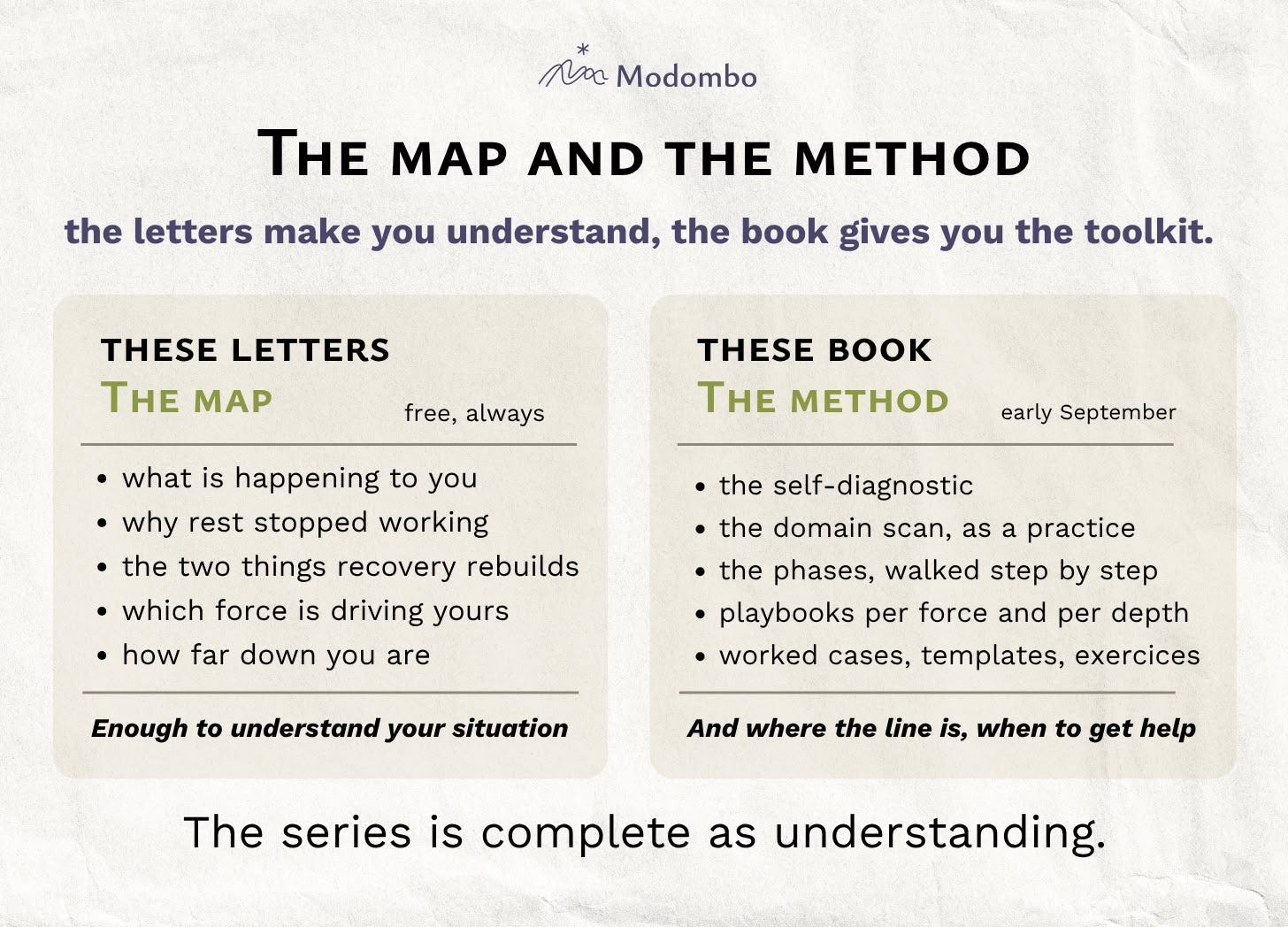
These letters are free and they stay free, and they are enough on their own to understand what is happening to you. The book is for the people who want to do the work rather than only understand it. It lands in early September, and if you are reading this anywhere other than your inbox, the letters arrive there first.
But you can start with the recognition, and the recognition is most of the shift. Once you have seen the driver, you do not fully unsee it. The next time you feel yourself say yes on empty, or treat a free evening as something that needs filling, you will catch it. That noticing is the compass coming back online.
The rest of this letter is for subscribers, and it is the practical half: a self-check that names which of the three drivers is spending you, a daily exercise for catching the override while it happens, a four-question first pass over where your reserve is actually leaking, and my own case walked through all of it.
