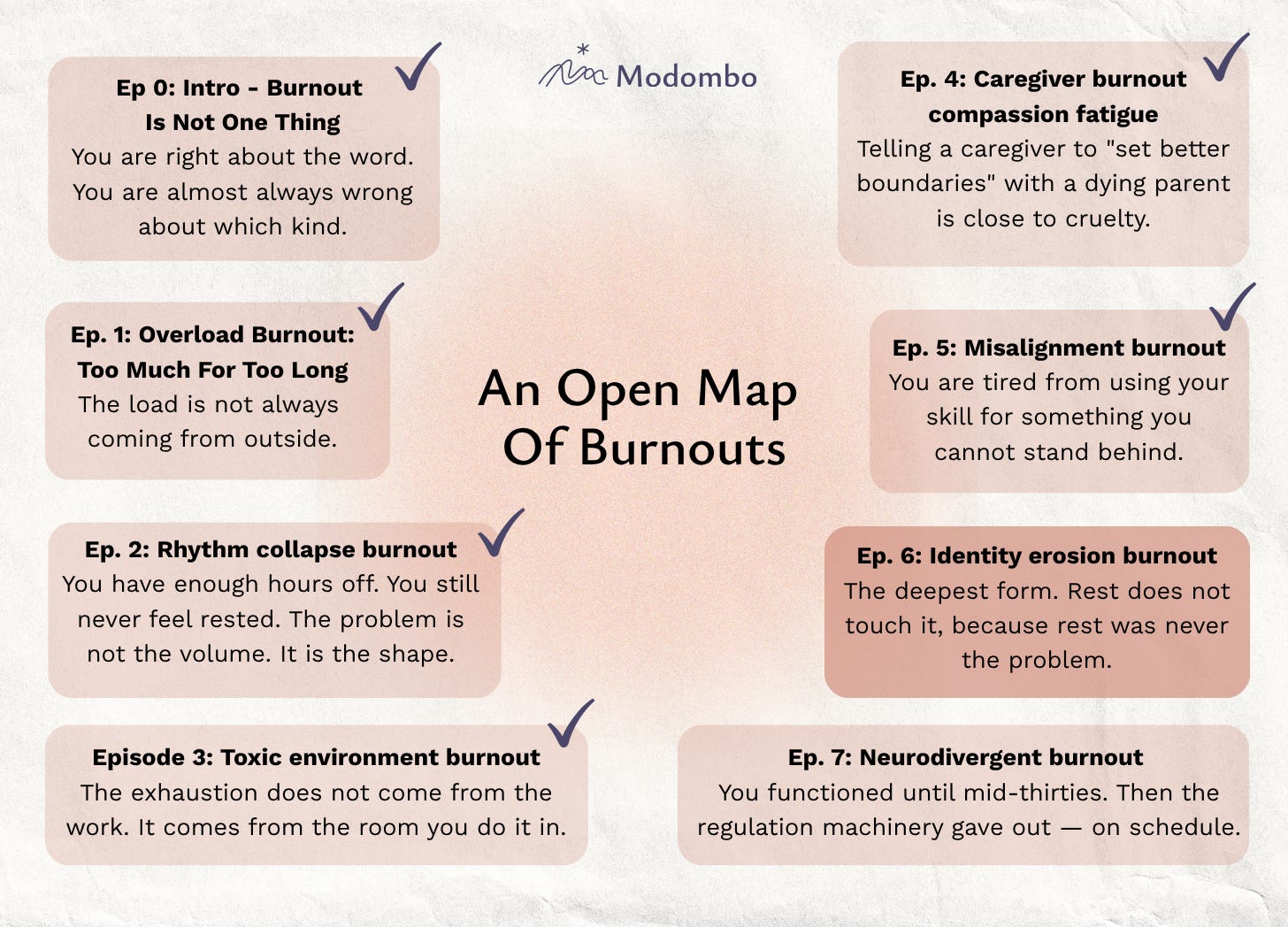
Misalignment Burnout — Right Role. Right Craft. Wrong Purpose.
You are not tired from the skill. You are tired from spending it on something you do not believe in.

The craft is fine. What the craft is being used for is not.
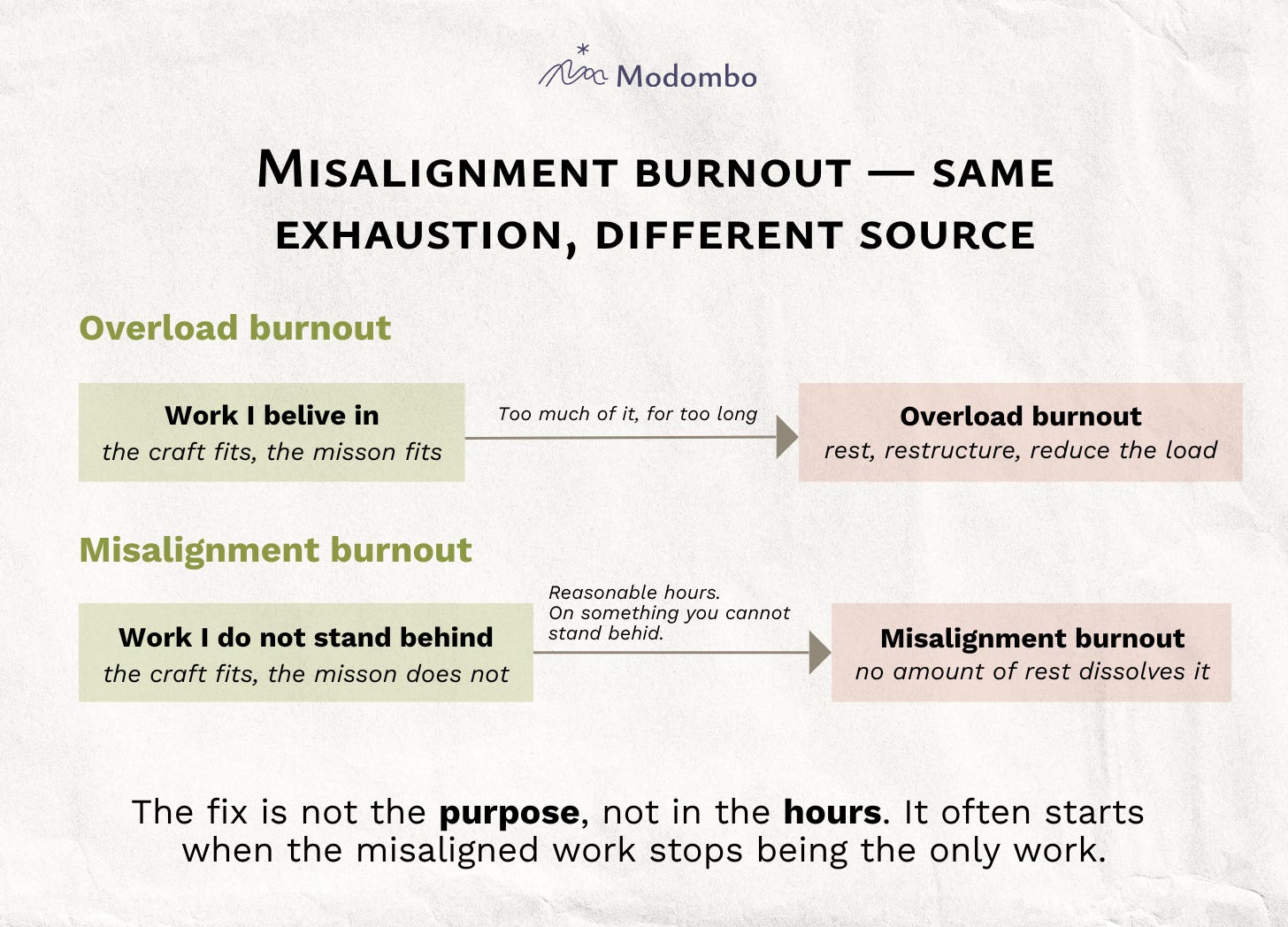
Most of the burnout conversation assumes the source is volume. Too many hours. Too many demands. Too little rest. Reduce the load, restore the person.
Misalignment burnout breaks that logic. The hours are ordinary. The demands are manageable. The person is good at the work and, at the level of skill, still enjoys it. What has gone off is one layer up: what the skill is being used for. The craft is fine. The mission is not.
I see this in lawyers who have become very good at defending cases they find morally indefensible. In engineers whose company pivoted into a sector they cannot get behind, while the day-to-day coding they loved stayed exactly the same. In therapists working inside clinic systems whose incentives quietly undermine the clinical judgement they were trained to trust. In designers who are excellent at making products more addictive and increasingly do not want to. The role fits them. The role’s purpose does not.
How it sounds in the room
“I’m good at this. I just can’t stand what we’re using it for.”
“I could do this job in my sleep. I cannot do it in good conscience.”
“I used to be proud of the company. Now I just work here.”
“Every week I trade something I believe in for something I do not, and the pay is not the problem.”
Why reducing the hours does not help
Volume-based advice assumes a linear relationship: less work, less burnout. For misalignment, the relationship is not linear. The same misalignment at 30 hours a week drains almost as efficiently as at 50. Fewer hours means slightly less friction, not resolved friction.
This is the burnout most likely to survive a sabbatical unchanged. The person comes back from six weeks off feeling rested and then, within a week or two, the old heaviness returns. They have not failed at rest. They have returned to the same mismatch between what they can do and what they are being asked to do it for.
Left unhandled, misalignment compounds in a particular way. Cynicism arrives, and then it arrives at the craft itself. The skill that used to be a source of pride starts to feel like a tool turned against the person. Every time it works well, it works in service of something they no longer believe in. The pleasure of competence goes flat, then sour. By the time someone names this out loud, they often say a version of I am too good at this for what it is being used for, and the contempt is no longer aimed only at the role but at the craft, and eventually at themselves for staying.
Money helps. Money is not a values system. When the only thing keeping you in the role is the paycheck, the paycheck quietly becomes the thing you resent most.
What actually helps
The first move is not an exit. It is an honest inventory of where the friction actually lives. Misalignment hides inside general grumbling about work, and most people cannot tell, from the inside, whether they are looking at real values conflict or at something smaller: ordinary irritation with imperfect management, frustration with a bad quarter, the ambient cynicism everyone carries by year ten in any industry. Or at something adjacent wearing the same costume: a culture that is genuinely harmful, which is toxic-environment territory, or a role that requires being someone you are not, which is the next episode.
The test is specific. If the organisation moved tomorrow toward the values you already hold, same hours, same colleagues, same pay, would the heaviness lift? If yes, this is misalignment. If the heaviness would still be there because the role itself is not one you would choose, you are in identity-erosion territory and the next episode is for you.
Try it concretely. Same craft, same hours, same colleagues, same pay, but the supply chain no longer runs through child labour in developing countries. Would the heaviness lift? Or: same craft, but the agency you work for has stopped making ads for casinos and slot machines. Would the heaviness lift? Or: same craft, but the company is no longer the one being named in court over the addictive product, or no longer the one quietly responsible for environmental damage that is technically legal and obviously bad. Would the heaviness lift? If the answer is yes to any of these, misalignment is what you have, and the friction was never the volume of work; it was the company you have been lending your skill to.
If the inventory points to real misalignment, the structural moves open up in sequence. Sometimes the role can be reshaped within the organisation: a different client mix, a different product line, a different team inside the same company. Sometimes the organisation cannot flex, and the move is lateral: different company, same role, different mission. Occasionally the whole industry has drifted and what is needed is an honest reappraisal of whether the work itself, not just the employer, needs to change.
One pattern worth naming: the change does not have to be a hard pivot. People in this crossroads often have unusual room to step out gradually. A client of mine spent years inside one of the large social media companies; as the scandals around its algorithm kept arriving without ever being resolved internally, he moved from full-time to part-time at a salary that kept him stable, then to external contract work on minor projects, and used the freed time to build the same craft inside a company that did not turn his stomach. The exit took eighteen months and never looked like a resignation. Misalignment, named early, often has this shape: the skill is portable, the contract can be renegotiated, the move is a slope rather than a cliff.
None of these are small moves. Misalignment is often where people make the best career decisions of their lives, once they name what is actually happening. The cost of staying is not usually seen until someone puts it into words: you are spending the years you have on something you do not stand behind, and the years do not come back.
Where this is, and where it isn’t
One question is enough to orient. If the same work served a purpose you could stand behind fully, would the exhaustion lift?
If yes, this is misalignment, and the work is structural: name the conflict, test whether the role can be reshaped, and if not, move the role to an environment that fits. If the exhaustion would still be there even with a purpose you believed in, the role itself is the problem, and the next episode is where you look.
What is coming in the next episodes?
Next — NL B6: Identity erosion burnout. The deepest form, and the one most commonly confused with misalignment. When the role itself is wrong for who you are, rest does not touch it and a better employer does not fix it — because the fix is not out there.