

Recovery Is Not Rest
Because rest was never the thing you were short of.

You did everything right, and nothing changed
You took the time off. Maybe a long weekend, maybe two real weeks. You slept. You stopped checking the messages, mostly. You came back on the Monday a little lighter, and you thought, good, that was what I needed.
And by Wednesday it was as if you had never left. By the second week the weight was sitting on you exactly where it had been before you went. You did everything you were told to do. You rested. And it did almost nothing.
You rested. The life that emptied you did not.
Most people draw the obvious conclusion from this, which is that something is wrong with them. They did not rest hard enough, or long enough, or they are simply broken in some way other people are not. I want to offer you a different conclusion, and it is the foundation of everything that comes next in this series.
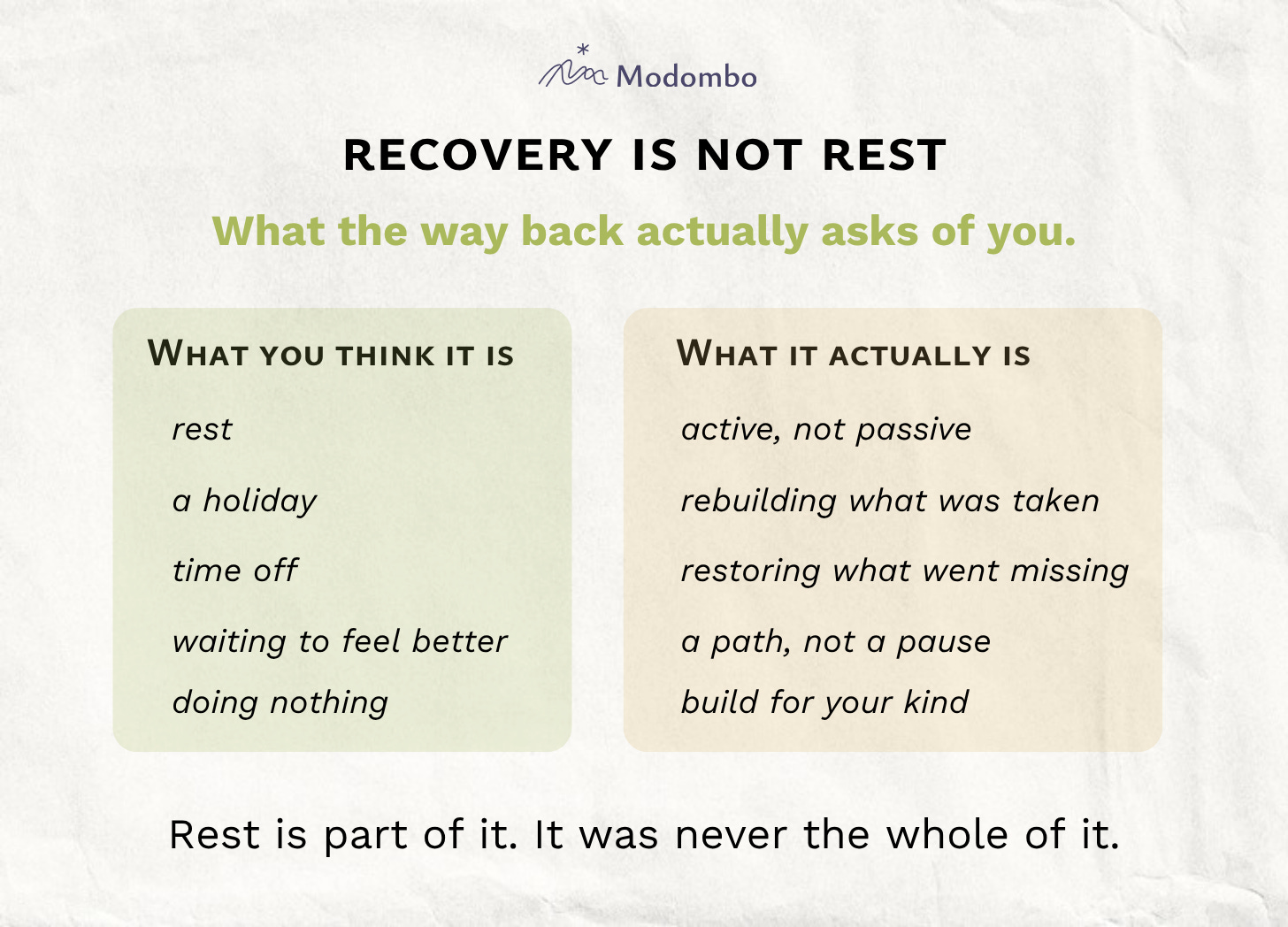
You were never going to rest your way out of this. Not because you did it wrong. Because rest was not the thing you were missing.
Where the myth comes from
We treat exhaustion like a fuel problem. The tank is empty, so you refill it, so you drive on. Tired means rest, rest means recovered, recovered means back to normal. It is clean and it is intuitive and for ordinary tiredness it is even true. A hard week, a good weekend, you are fine.
But chronic overload was never an empty tank. That is the whole point of the last nine episodes. It is not a quantity of fuel you ran low on. It is something structural about how your life spends you, and a structure does not refill. You can pour all the rest in the world into a life that is shaped to drain you, and the life will keep draining you, because nothing about its shape has changed. The rest does not fail because it is weak. It fails because it is answering a question you were not actually asking.
This is why the holiday undoes itself by the second Sunday back. You did not return to a topped-up version of your life. You returned to the same machine, and it went back to work on you immediately.
What recovery actually is
So if it is not rest, what is it.
Recovery is deliberate, and it is aimed. It is not a pause you wait out, and it is not always about doing more. Sometimes the most deliberate thing you can do is genuine rest. But it is always chosen, and it is always pointed at one particular thing you have to rebuild. And what you build is not a return to the version of you that existed before, because that version was already walking toward this. What you rebuild is what the overload quietly took while you were busy carrying it.
That last part is the key to the entire series, so let me be plain about it. Overload does not take the same thing from everyone. From one person it takes their say over their own time. From another it takes the sense that what they do means anything. From another it takes the simple ability to ever feel finished. The way back, then, cannot be one thing either. It has to be aimed at whatever was actually taken from you. Rest is a generic answer. Recovery is a precise one.
This is also why the standard advice is a coin toss, the same way it was a coin toss in the last series. “Do less, rest more” is exactly right for the person whose problem really was too much. It is close to useless, and sometimes quietly insulting, for everyone whose problem was something else entirely.
The tank, and the thing that keeps emptying it
There is a second reason rest alone does not hold, and it is worth naming now even though we will spend a whole episode on it later.
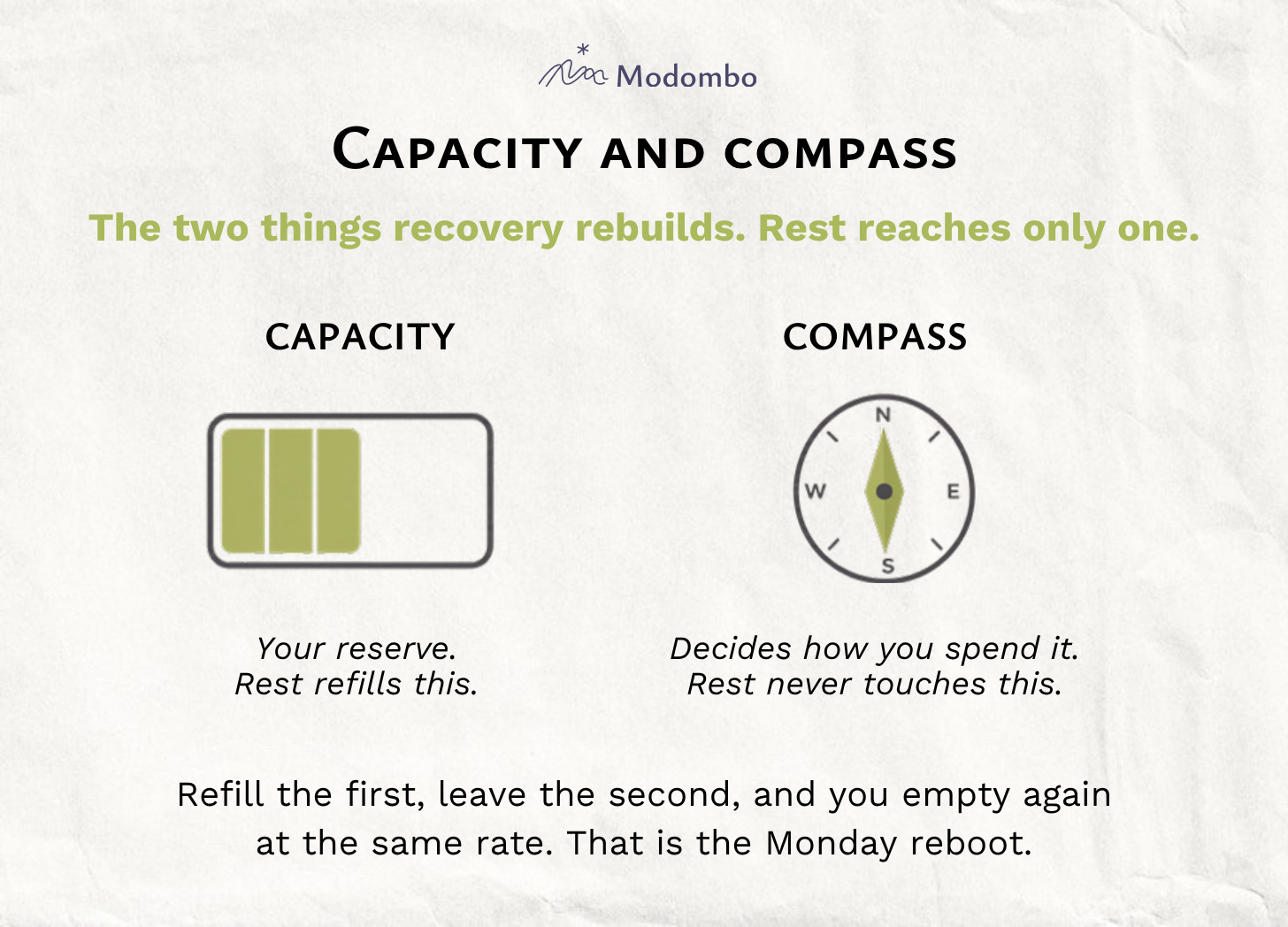
Rest refills your capacity. It does nothing about the part of you that keeps spending it. Even when rest does refill you, it does not touch the thing that keeps emptying you. You can restore the energy and leave completely intact the part of you that overspends it, the part that says yes again, that cannot leave the work alone, that treats its own needs as the last item on a list that never ends. Rest hands that part a full tank and it spends it at exactly the same rate. That is the Monday reboot. It is not weakness. It is what happens when you refill the fuel and never look at the driver.
Real recovery rebuilds two things: your capacity, and the compass that decides how you spend it. Restore only the first and you are back here in a month. We will get into how you rebuild the second, because it is the more interesting half and almost nobody talks about it.
The honest part
One promise I will keep through this whole series: I am not going to pretend this is fast or that it feels good while it happens.
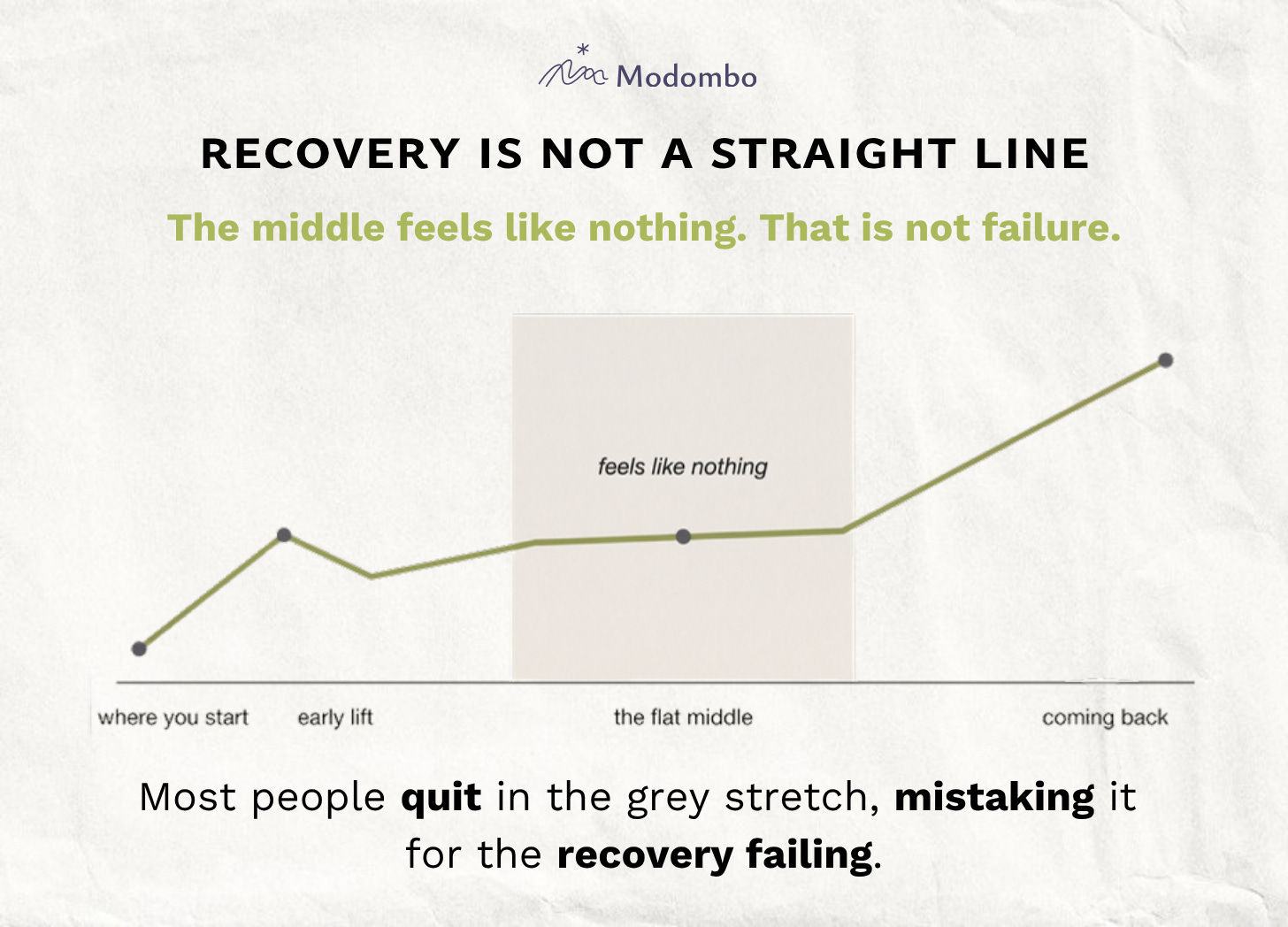
Recovery is slow, and it is not a straight line, and there is a long stretch in the middle of it that feels like nothing at all. Not better, not worse, just flat and grey and unconvincing. Most people hit that stretch and decide it is not working, and they either give up or they fling themselves back into the old pace to feel something again, and they undo the whole thing. That flat middle is not the recovery failing. It is very often the recovery working, in the only way it can at that stage. Knowing that in advance is half of getting through it.
Why this is a series and not a single answer
If the way back depended only on rest, this would be one short post and we would all be done. It does not, so it is not.
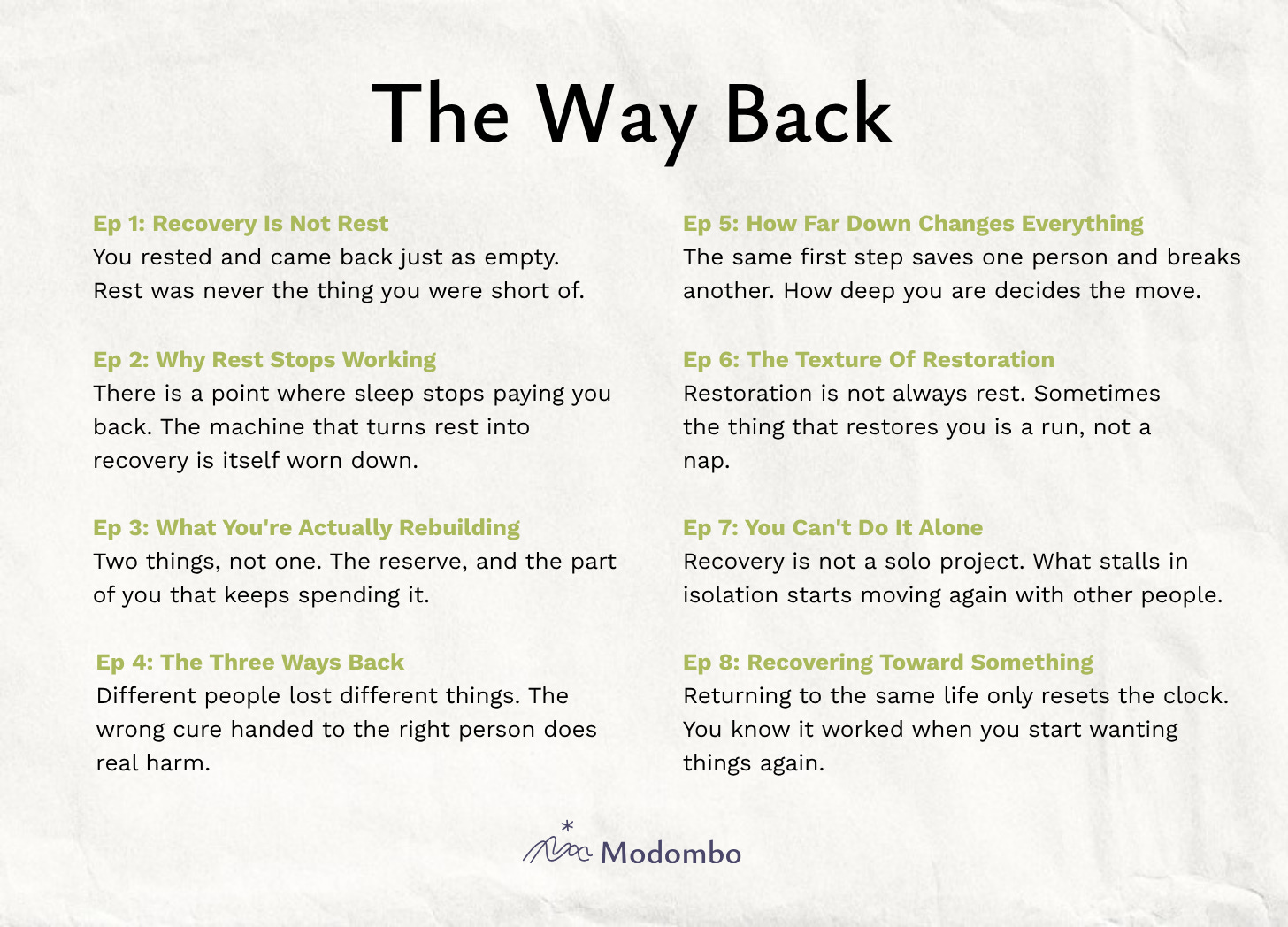
Over the next episodes I am going to walk through what recovery is actually made of. Why rest stops working past a certain point, and what replaces it. The different ways back for different people, and how to tell which one is yours, because handing the wrong one to the right person does real harm. How far down you are, and why that changes the very first move you should make. And the part nobody admits, which is that you cannot do most of this alone.
The newsletter is the map. It will show you the whole terrain and where you stand in it. The full method, the actual step by step of how you walk it, is the thing I am building into a companion e-book, because it does not fit in a series of letters and you should not have to assemble it yourself from fragments. But you will finish this series understanding your own situation completely, which is the thing that has to come first anyway.
Where this leaves you
You spent the last series learning that your burnout had a particular shape. This series is about the fact that your recovery has one too, and it is not the shape you were handed.
Recovery is not the absence of effort. It is the most precise effort you will ever make, aimed at exactly the thing that was taken from you. Rest is part of it. It was never the whole of it.
What’s coming next
Next time: why rest stops working at all. There is a point on the road where sleeping more genuinely stops helping, where the machinery that turns rest into recovery is itself worn down, and where the only honest first move is to rebuild that machinery before anything else. If you have ever rested properly and woken up just as empty, that episode is about you.
I’m into this topic but I feel like the infographics are the most pointed part of this. The rest feels meander-y and redundant. It’s hard to parse what you’re getting at. Then it ends abruptly. I want to better understand