Silent Overload — The Burnout With No Cause To Find
You kept looking for the thing that was wrong. There wasn't one.

When nothing is wrong and you’re collapsing
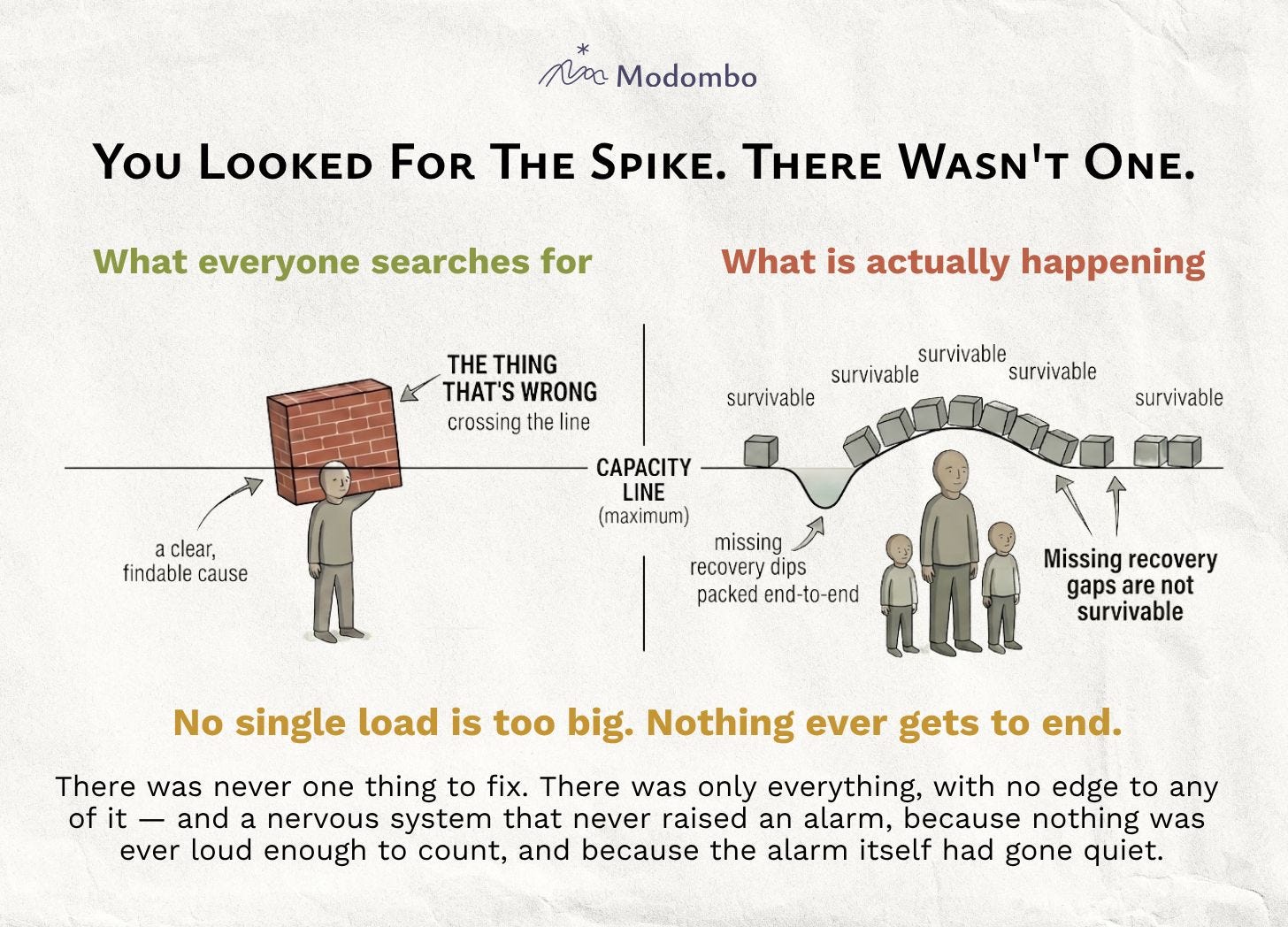
You go looking for the cause and there isn’t one. No crisis, no villain, no crushing workload. Every part of your life would pass inspection. And you are depleted in a way you cannot account for. The missing cause is not a sign you are imagining it. The missing cause is the diagnosis.
Reasonable on every line, unsurvivable in total. The load is real. It is just spread out. A demanding but fair job. A family that needs you. Admin that never ends. A home, friendships, your own standards. Take any single line and it is fine. Add the page up and there is no slack anywhere, and no edge to any of it.
Nothing ever finishes. This is the mechanism, and it is not about the size of any one thing. It is that nothing closes. There is always something unfinished, always the next thing arriving before the last one landed. The recovery that is supposed to happen in the gaps never gets a gap to happen in. Rest stops restoring you — not because you rest wrong, but because the day has no seams left to rest in.
No alarm goes off. Unlike the burnout that comes from a hostile room, this nervous system is not screaming. No racing heart, no dread, no visible pressure. And there is a reason the alarm stays quiet. Run under steady load for long enough and the internal signal itself goes dim: the system that is meant to tell you this is too much gets blunted by the very thing it should be reporting. So you stay calm. You perform. You deliver. You look fine to everyone, yourself included, while the reserve drains for months or years. The calm is not safety. It is the gauge going dark.
And then something small takes you down. The crash arrives over something trivial. A cancelled plan, a minor mistake, a jammed printer — wildly out of proportion to the trigger. You decide you have overreacted, that you are weak, that you are losing it. You have not. The small thing did not cause the collapse. It was just the first thing big enough to show you there was nothing left underneath.
How it sounds in the room
“I don’t have anything to complain about. That’s the part that scares me.”
“On paper my life is good. So why can’t I get up off the floor?”
“I’m not stressed. I’m just tired of everything.”
“I cried because the printer jammed. The printer was not the problem.”
“Everyone keeps asking what happened. Nothing happened. That’s the whole point.”
The person usually cannot name a cause, and often apologises for not being able to. There is genuinely no single overload to find. There is a whole life being carried at full saturation, with nothing in it ever coming to an end.
Nobody sounds the alarm for a life that looks fine on paper. Least of all the person living it.
Why a reasonable life never closes
No nameable cause does not mean no reason. It means the reason is not the kind you would find by asking “what’s stressing you out?” — there is no villain to point to. Sometimes there is genuinely nothing underneath: the life is simply full, reasonable, and seamless, and that alone is enough to empty you. But often there is also a quiet engine keeping the loops open, and naming it helps, because it tells you what letting something finish will actually cost you. Three show up again and again.
The proof-keeper. Every role is evidence. The firm, the board seat, the thing you organise for everyone else — each one quietly answers the question am I worth anything? Closing a loop is fine in theory; dropping a role is not, because it removes a piece of the proof. So nothing gets to end, and the page stays full.
The starter. Starting is alive. Finishing is flat. New things keep getting opened because the opening is where the energy is, and the old ones stay half-done rather than closed. What drains you is not the doing — it is the dozen things left mid-air, none of them landed. (If this is your whole wiring rather than a habit, the ADHD episode is the better home; here it is the open-loop pattern itself.)
The can’t-refuser. Saying no feels faintly dangerous, as if something will go wrong or someone will be let down. So the yes goes out before you have checked whether you have any room, and the list never stops growing.
Underneath each one sits a different feeling — and that is the part worth seeing plainly, because the busyness is not only load. It is also a way of staying in motion so the feeling never quite catches up.
Knowing which one is yours changes where the work is. The proof-keeper has to learn that an ended thing does not subtract from their worth. The starter has to sit in the quiet of a finished loop without reaching for the next one. The can’t-refuser has to find out that the feared thing does not, in fact, follow the no.
Why standard advice misses
Two reasons.
The first: the advice tells you to find the cause and reduce it, and there is no single cause to reduce. “What’s the one thing stressing you out?” has no honest answer. Cut any one thing and the gap closes over instantly, because everything else is still running and still does not end. So the person fails even at being diagnosed, and quietly adds that to the pile.
The second: because nothing looks wrong, what arrives instead is “but your life is good, you should be grateful.” Which lands as guilt on top of depletion. The very reasonableness of the life becomes one more reason to feel you have no right to be this empty.
What actually helps
Name it as accumulation, not a missing cause. The first relief is understanding there is no smoking gun to find, because the load was always the sum and the never-finishing. You are not too slow to spot the obvious problem. There isn’t one. “I’m not broken. I’m overloaded” is, here, the accurate sentence.
Recovery is closure, not subtraction. The fix is not doing less of any one thing, because each one is reasonable. It is building completion back in. A clean gap between things. An edge to the day. The plain experience of one thing actually ending before the next begins. Protected closure, not just protected time.
Reduce the number, not the size. Where there is a lever, it is usually the count of things running at once, not the size of any single one. Fewer simultaneous open loops, even for a bounded while, does more than shaving an hour off one of them.
Read the calm as data, not safety. For this profile the absence of alarm is the trap, and now you know why: the loud signals never fire because the channel that carries them has been dampened. So the gauges that matter are the quiet ones. Sleep starting to shift. Appetite changing. Interests narrowing. The small daily pleasures going missing without your noticing they have gone. Those are the readouts here. Learn to watch them, because nothing else will warn you.
Treat the small crash as the gauge, not a verdict. When you go down over something trivial, read it as the needle finally hitting empty, not as proof you are fragile. The reaction was the right size for the debt. It was never about the trigger.
Is this just depression?
It can look like it from outside — flat, hollow, floored by something small — and left long enough, overload can seed a real depression. But early on there is a tell, and it is wanting. In depression the wanting itself goes flat; you cannot summon the desire for the better life. In silent overload the wanting is painfully intact: you can picture the rest, the unhurried evening, the week that finally breathes, and it aches that you do not have it. A second tell is capacity — most people deep in depression cannot keep a full life running at all, and here you are, still running it. If the wanting is alive and the life is still standing, this is overload. If the wish itself has gone quiet — if you no longer want the better life, only the off switch — the line has moved, and that is worth saying out loud to someone who can help.
Where this is, and where it isn’t
A few questions, in order.
Can you actually name what is wrong, or is the honest answer “nothing, and that’s what unsettles me”?
Is any single part of your life clearly too much, or is each part reasonable and the whole page impossible?
Does anything in your week actually end, or is there always something already arriving?
Did your own crash come over something small you cannot believe knocked you down?
If you can point to a driver — too much work, the wrong rhythm, a hostile room, a person you cannot put down, work against your values, a self you are holding down, a nervous system tuned differently — start there, because one of the earlier episodes is written for exactly that. (The three quiet engines above are a different layer: not an external driver but the reason a reasonable life never closes. A distinct nervous system, an eroding sense of self, or one specific relationship you cannot put down still belongs to its own episode.) If the honest answer is that every line is fine, the whole page is unsurvivable, and no alarm ever rang, this is the one.
Nothing was wrong, and that was exactly the problem. The load was never in any single place. It was in the fact that, anywhere in your life, nothing ever came to an end.
What is coming in the next episodes?
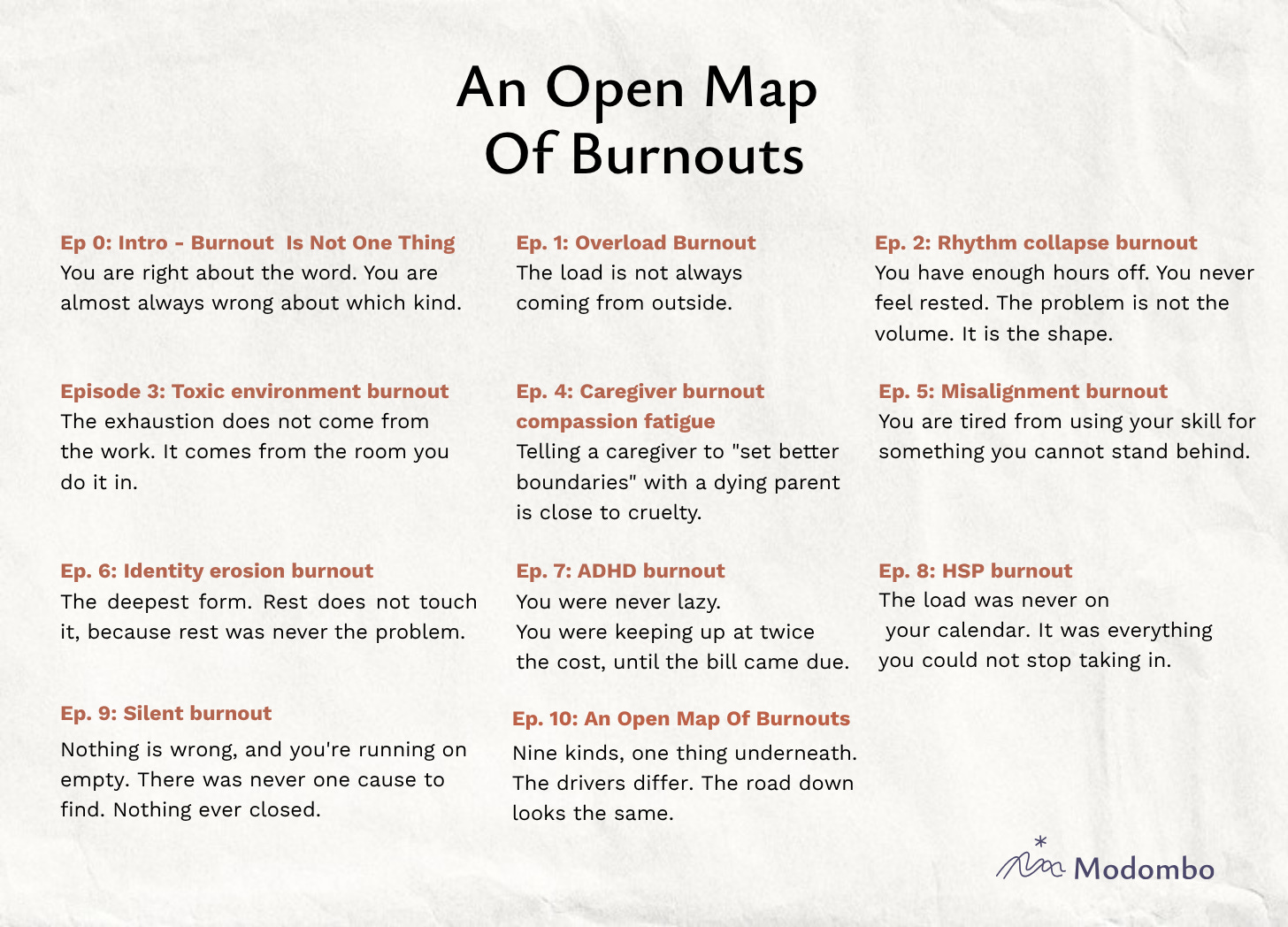
Next, and last in the series: the map itself. Nine shapes, one thing underneath all of them. What every one of these burnouts has in common, why the word kept failing you, and why naming the shape was the whole point from the start.