

Why Rest Stops Working
What breaks is not your energy. It is the machine that turns rest into it.

The rest that did nothing
This time you did it properly. Not a busy holiday with the laptop in the bag, a real one. You slept until you woke up on your own. You stopped checking. You came back genuinely rested, in the plain physical sense, and you waited for the rest to turn back into feeling like yourself.
It did not. You were rested and still empty. Rested is a thing you can almost measure, and you had it, and underneath it nothing had moved.
You rested properly and woke up just as empty.
I know that line from the inside. My first company ran straight into the years after 2008, and for close to two years I worked with almost no weekends, never mind a holiday. When it finally eased and I let myself rest again, started meditating, took real time off, the rest did not come back as recovery. It came back as a demand for more rest. Whatever energy returned did not feel like being restored. It felt like just enough fuel to want to escape the whole thing. I came close to giving up on entrepreneurship altogether, and I could not have told you why resting was not working.
Most people meet this and quietly decide the problem is them. They must have rested wrong, or not long enough, or they are simply built weaker than whoever this works for. The truth is less personal and more useful. You did rest. Rest just stopped being the thing that pays you back.
Two kinds of tired
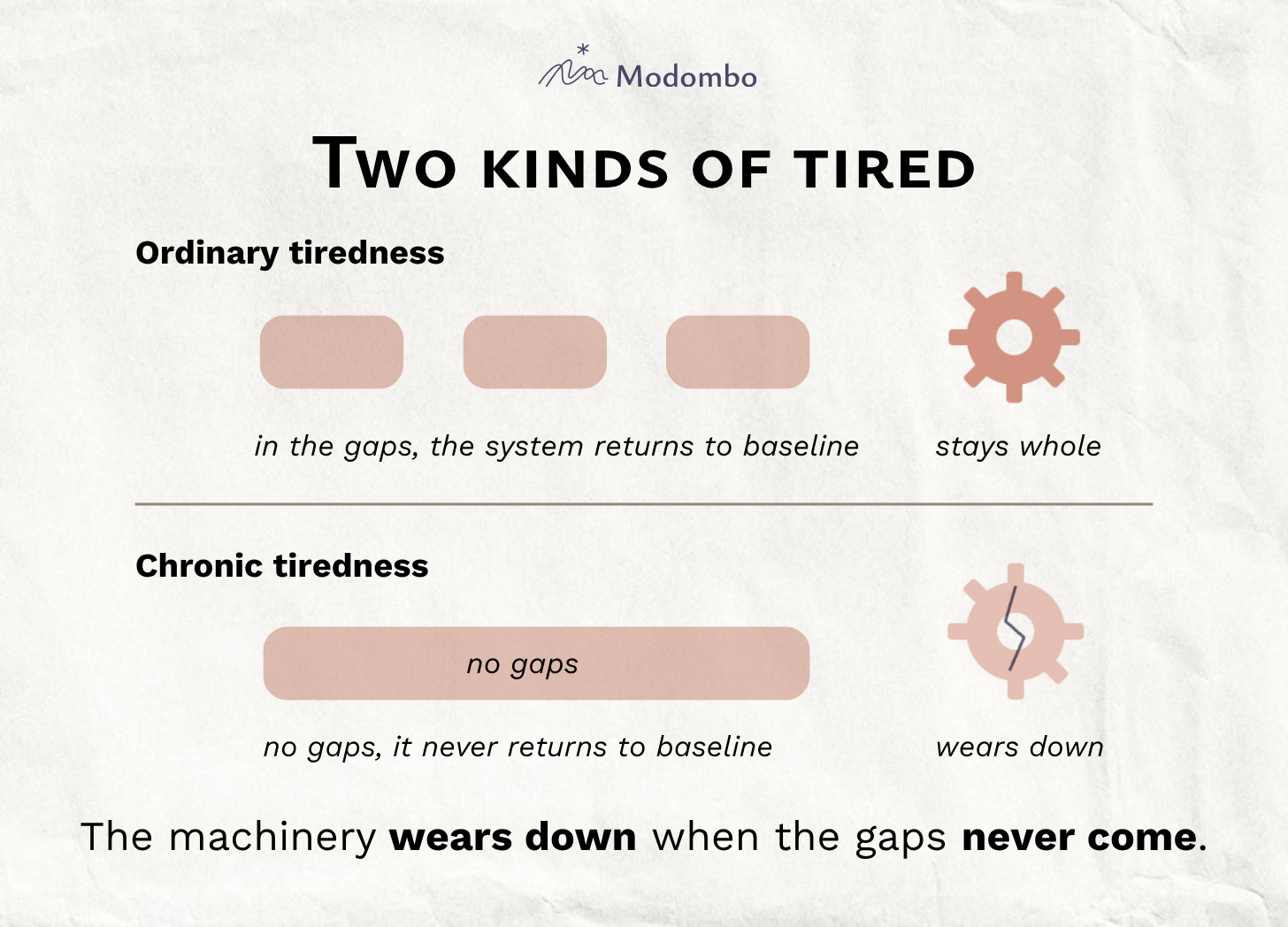
There are two situations that wear the same word, and only one of them answers to rest.
The first is ordinary tiredness. A hard week, a short night, a heavy month. The tank runs low, you refill it, you carry on. This is the model everyone keeps in their head, and for this kind of tired it is exactly right. I said as much last time. A good weekend and you are fine.
The second kind is what the first turns into when it runs too long without relief. It feels like more of the same, only heavier, so you reach for the same answer. And the answer stops working. Not because you are doing it wrong, but because the second situation was never the first one scaled up. It is a different thing, and it is not about how empty the tank is. In the first, the fuel is low. In the second, something about how you turn fuel into energy has stopped working the way it used to. The machinery wears because the demand never let up long enough for it to catch up, and a system that never gets to recover eventually loses the ability to.
The catching up happens in the gaps between demands, and those gaps are not idle time. They are the recovery half of a rhythm. A stretch of demand, then a gap where the system settles back to baseline and the cycle completes. That rhythm is what keeps the machinery whole. Take the gaps away, run demand with no return, and the cycle never completes. The part of you that depends on it completing is the part that wears.
The machine that turns rest into recovery
Here is the part almost nobody names. Rest and recovery are not the same thing, and the gap between them is where all of this lives.
Rest is an input. It is the raw material. Recovery is what a working nervous system does with that material. It takes the rest and converts it. It discharges the activation you have been carrying and lets the system drop out of its constant readiness. Underneath that, slowly, it rebuilds the reserve you have been running on. That conversion is a real physiological process, and like anything that runs too hard for too long, it can wear down.
Past a certain point, what breaks is not your energy. It is the machinery that turns rest into energy. So you sleep eight hours and it hands you back three. You take the two clear weeks and get a long weekend’s worth of return. The rest is going in. Almost nothing is coming out, because the part of you that does the converting is worn down along with everything else.
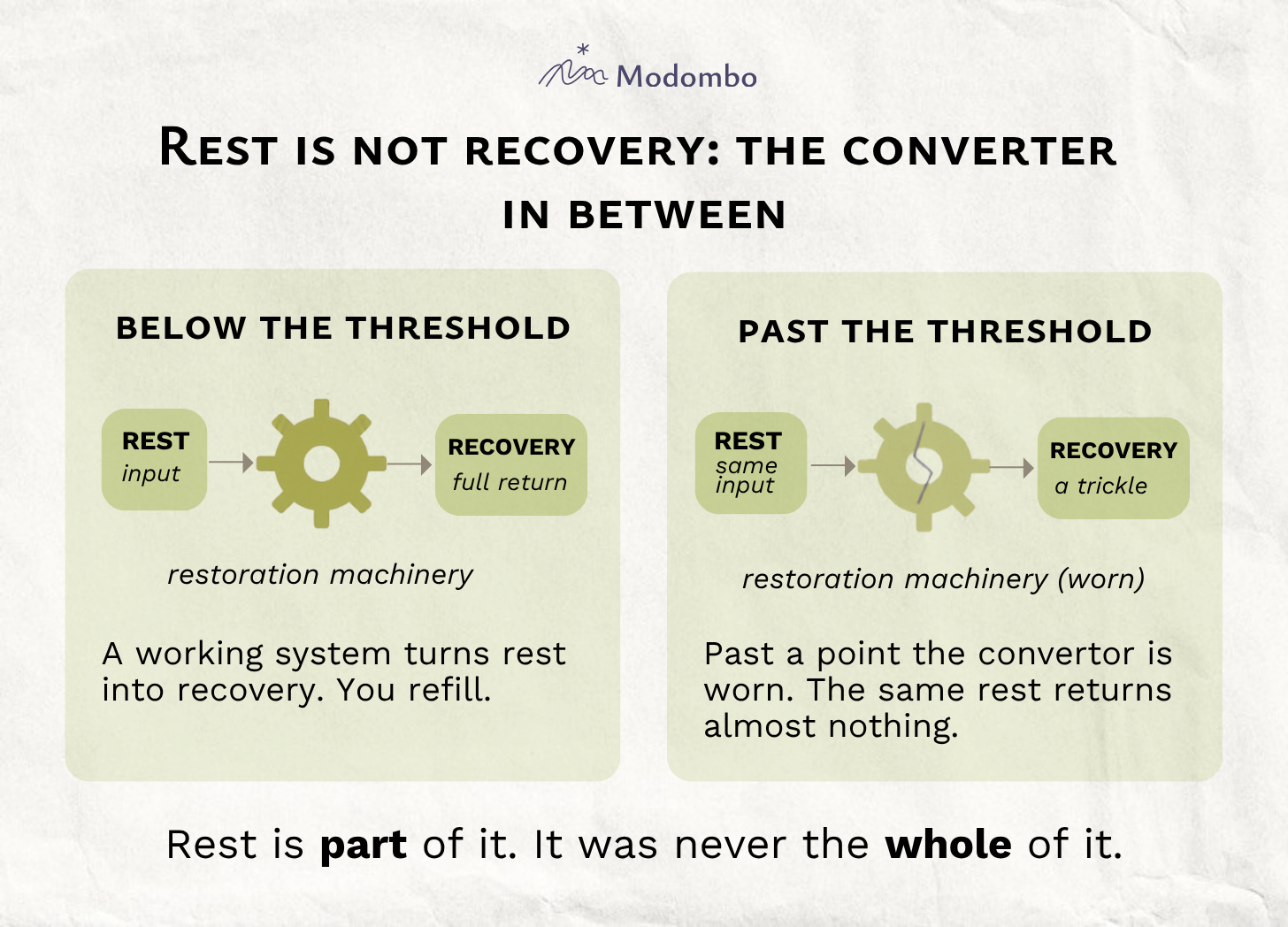
This is why the tank picture only takes you so far. It was never really about how full the tank was. It was about the pump, and the pump is tired too.
The flat grey middle
Now the part that catches almost everyone.
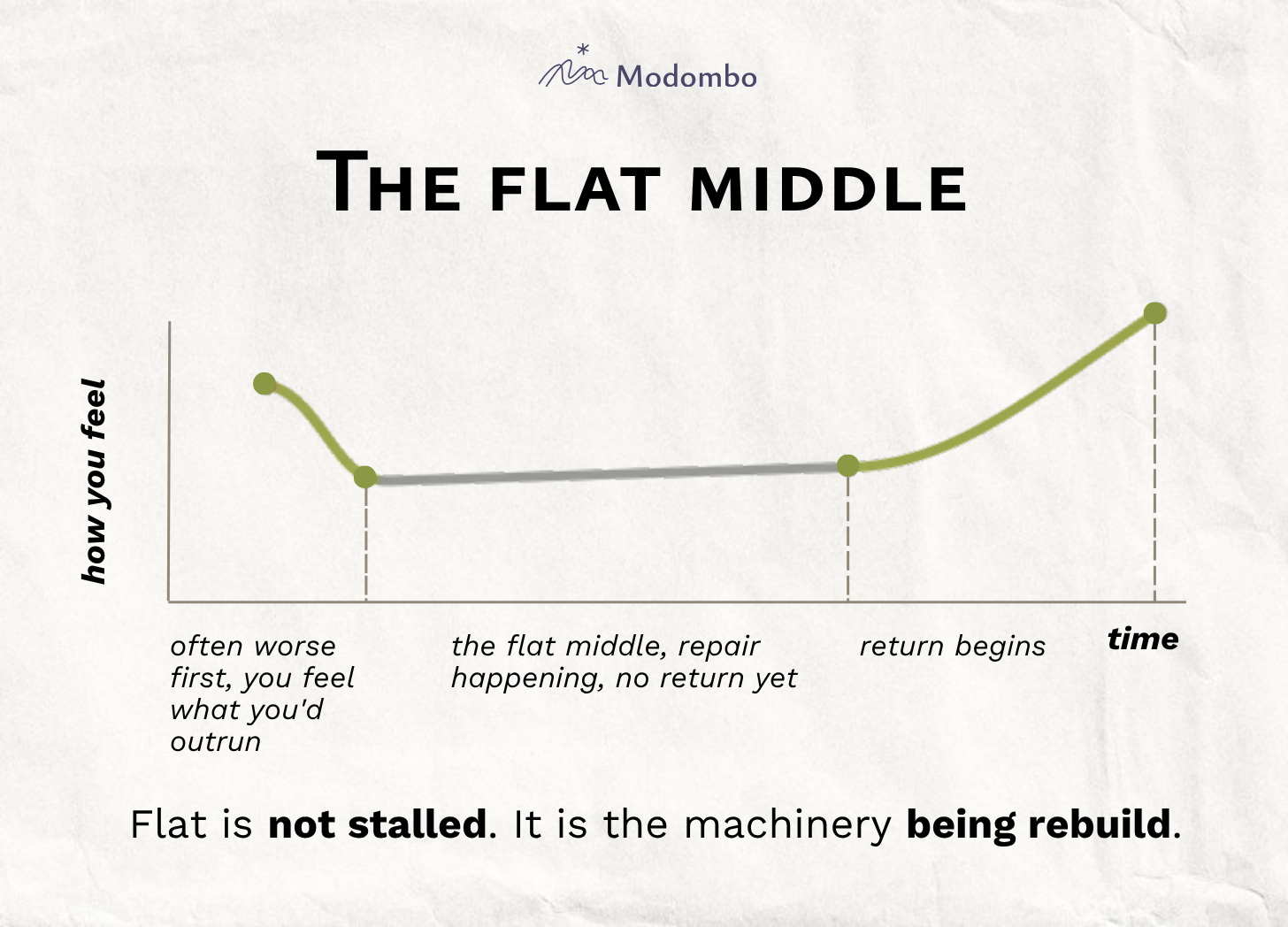
Often it feels worse before it feels like anything, because the moment you stop outrunning the overload you start to feel what you had been outrunning.
When the machinery does start to come back, it does not announce itself. Rebuilding a worn system is quiet, invisible work, and for a long stretch it produces no signal you can feel. You are not worse. You are not better. You are flat and grey and fairly sure nothing is happening at all.
I flagged this stretch last time as the one most people mistake for failure. Here is why it happens. The converting machinery comes back online before the return does. There is a gap between the repair starting and the repair paying out, and that gap is the flat middle. It feels like nothing precisely because the work is happening one layer below where feeling lives.
The flat middle is not the recovery stalling. It is the machinery being rebuilt before it can pay you anything back. Nearly everyone who gives up gives up here, because this is the one stretch that looks identical to failure while being its exact opposite.
Why this changes the first move
If the thing that is broken is the converter, then pouring in more rest is answering the wrong question. You can keep feeding input to a system that cannot convert it and watch it change nothing. That is what the failed holiday actually was.
So the first real move in recovery is not more rest. It is rebuilding the machinery that makes rest work again. That is a different kind of move, and it comes before the rest can do its job, not after.
How you actually rebuild it is a longer story than a letter can hold, so I am putting it into a short companion e-book, out in early September. This letter gives you the map. The book gives you the method.
I will not pretend that is intuitive. Everything in you, when you are this tired, wants the answer to be rest, because rest is the thing you feel starved of. But you cannot rest your way into a working recovery system. You rebuild the system first, and then rest starts paying you back the way it used to.
The rest of this letter is for subscribers, and it is the practical half: a short self-check that tells you whether your tiredness is the ordinary kind or the worn-converter kind, a one-week audit of where your calendar actually lets the cycle complete, one starter practice for reinstating a real gap, and what to watch for during the flat middle so you do not give up inside it.
